
Authorized Septic Repairs
Don’t guess with your septic system.
We follow a strict technical process to ensure your repair is compliant, safe, and effective.
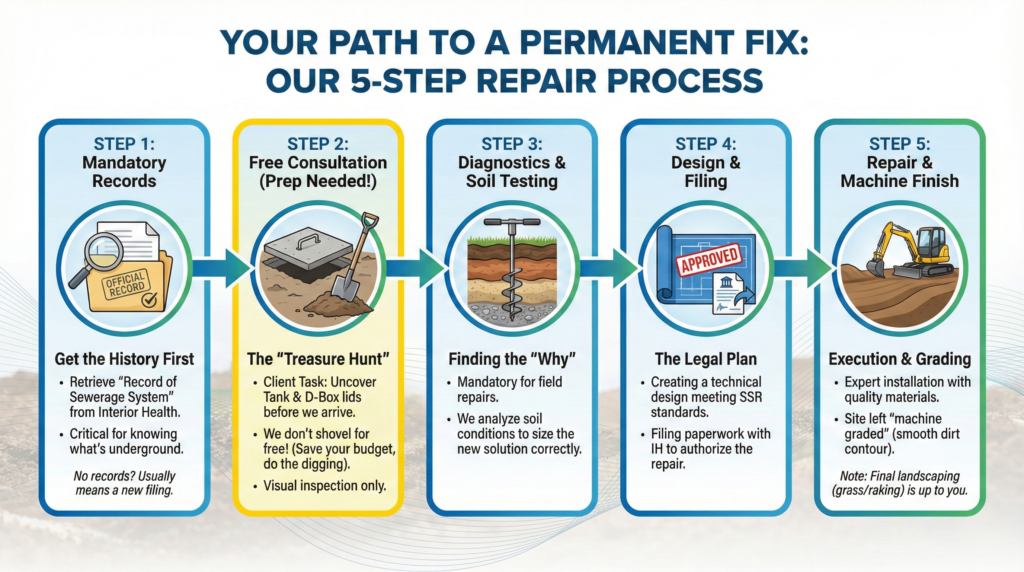
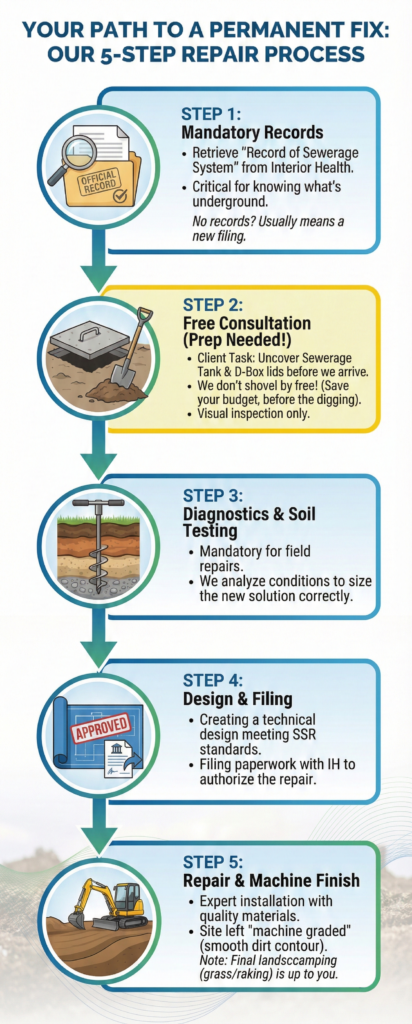
STEP 1
Obtain Your Official Septic Record (Required)
Before we can calculate your system’s capacity, we need to verify exactly what is installed underground.
The Interior Health Authority (IH) holds these official records. You must retrieve this document first.
Please be aware that IH charges a fee for this search, which is non-refundable even if no records are found (common with older or unpermitted systems).
Visit the Interior Health Portal:
Find the Section:
Scroll down to locate the section titled “Locate an on-site sewage record”.
Follow the Instructions:
Complete the 3 steps listed there (Fill Request Form -> Submit to Email -> Pay the ~$50 IH administrative fee).
Note: This administrative fee is paid directly to Interior Health, not to us.
STEP 2
Free Onsite Consultation (Visual Only)
Once we have your records, we will schedule a visit.
To keep this consultation FREE, we need a little help from you. We cannot inspect what we cannot see!
How to prepare for our visit (and save money):
• The “Treasure Hunt”:
Please uncover the lids of your Septic Tank and the Distribution Box (if your system has one) before we arrive.
• Save Your Budget:
Our team is great at diagnostics, but you really don’t want to pay our technical rates just for shoveling dirt! To keep the consultation free, please do the digging yourself.
• Can’t find it?
No problem. If the components are playing hide-and-seek and you need us to bring in electronic locators or cameras, we can certainly help-but please note this is a billable service, not part of the free consultation.
STEP 3
Diagnostics & Soil Testing
Mandatory Soil Testing:
• All drain field repairs require valid soil testing to determine current design needs.
• We analyze the soil conditions to ensure the ground can accept the daily flow.
STEP 4
Design & Filing
• We create a technical design that meets Sewerage System Regulation (SSR) standards.
• We file the necessary paperwork with Interior Health to authorize the repair.
STEP 5
The Repair & Finish
Our team executes the repair using proper materials and techniques.
Site Finish:
• Once the repair is done, we backfill and leave the area “machine graded”.
What this means:
• We tidy up the heavy earthwork to a smooth contour. However, final landscaping touches-like raking, topsoil spreading,
or grass seeding-are left to you, so you can style your garden exactly how you like it.
Ready to restore your system?
You have the records. We have the solution. Let’s get things moving.
Building a Shop, Pool, or Home Addition?
If you are planning to build a new workshop, home addition, or install a pool, you might discover that your existing septic tank
or dispersal field is located right inside your new building footprint. Many homeowners don’t realize that you cannot simply “move” old septic components. Health regulations and practical physics require that components in the way be officially decommissioned (safely abandoned or removed) and brand-new components be designed and installed in a different,
approved location on your property.
How we help keep your construction project on track:
• Proper Decommissioning:
Safely crushing, filling, or removing old tanks and fields that are in your way, strictly following Interior Health guidelines.
• New Component Installation:
Designing and installing a new dispersal field or tank in a compliant location on your lot.
• System Upgrades & Tie-ins:
Connecting the plumbing from your new shop, carriage house, or addition into a legally sized system.
• Regulatory Compliance:
Handling the necessary filings so your new building permit doesn’t get blocked by septic issues.
Don’t let your existing septic system halt your construction plans.
Contact us for a site assessment before you finalize your blueprints!